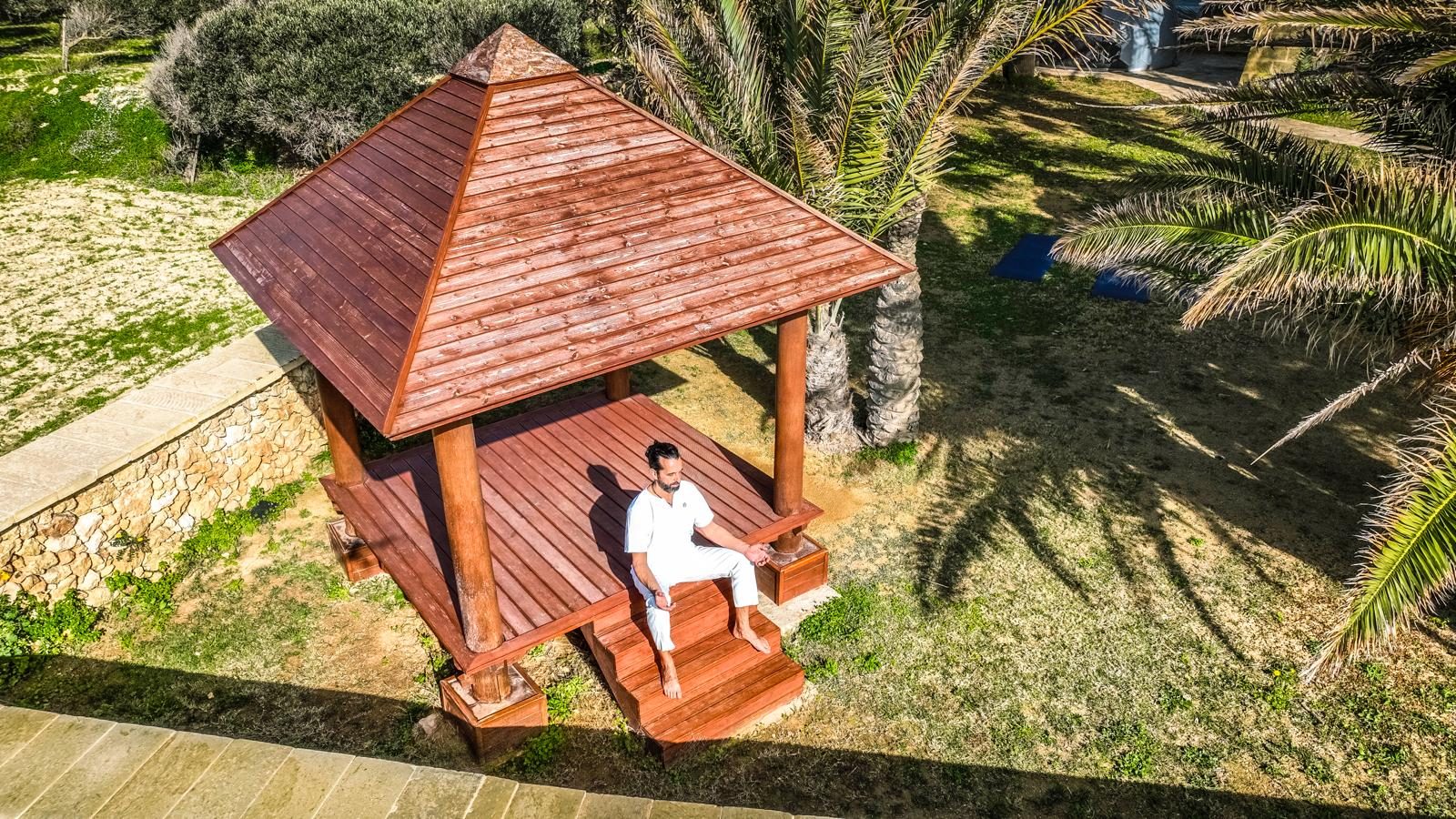
HIVE BIO runs ketamine-assisted therapy for PTSD and complex trauma in Malta, at a house in San Lawrenz on the western edge of the island. Two doctors, one of them a consultant psychiatrist, assess you before you pay for the programme. Then comes one week in residence with individual ketamine-assisted sessions, a doctor and a nurse beside you through each one, four guests at a time, and three weeks of online integration with the same team once you are home. You can apply from the UK, Ireland or anywhere else in Europe without a referral letter.
Across most of Europe, ketamine for trauma is given as a series of outpatient appointments: a dose at a clinic in your city, then home the same afternoon. A residential week puts the sessions, the therapy and the days in between under one roof and with one team.
Where ketamine-assisted therapy for PTSD is offered in Europe
There are three routes, and they differ in who sees you first, who works with you between sessions and what happens after the last one.
| Route | Where | Who sees you first | Therapy around the sessions | After the last session |
|---|---|---|---|---|
| Outpatient series | Private clinics in larger cities, in some countries | A doctor at the clinic | Often arranged separately, with a therapist you find yourself | Depends on the clinic |
| UK self-pay service | Oxford Health NHS Foundation Trust | Its own consultant | Arranged by the service | Follow-up with the service |
| Residential week | HIVE BIO, San Lawrenz | A consultant psychiatrist and a second doctor | One to one with a therapist who knows you from the preparation weeks | Three online integration sessions with the same team |
In the UK the outpatient route is narrow. The ketamine service at Oxford Health takes new patients only from Oxfordshire and Buckinghamshire, according to its own FAQ. From Ireland the options at home are few, and how people from Ireland reach treatment abroad is set out on its own page. Inside the EU, access turns on national rules and on finding a prescriber.
Our programme has no postcode rules and no GP letter to wait for, because our psychiatrist sees you directly.
What the PTSD trials show for ketamine with therapy alongside
The trial that set the direction gave people with chronic PTSD six infusions over two weeks, against midazolam, a sedative that is harder to tell apart from ketamine than a saline drip. Of those on ketamine, 67% responded, against 20% on midazolam, and among the responders the effect lasted a median of 27.5 days after the course (Feder and colleagues, American Journal of Psychiatry, 2021).
The same team then added five sessions of a short written exposure therapy to the same six infusions, in an open trial of 14 people with severe chronic PTSD. Nine of the 13 who finished responded, and in eight of them the response held when they were assessed up to six months on (Feder and colleagues, Journal of Clinical Psychiatry, 2025). There was no comparison group, so it shows what the combination can look like, and the authors call for larger randomised trials.
A 2026 systematic review pooled seven randomised trials and 323 people. Courses of several doses did better than single doses, and the authors concluded that ketamine may be effective in PTSD and that trials pairing it with psychotherapy are the next step (Yin and colleagues, Acta Psychiatrica Scandinavica). The largest single trial, in 158 veterans and service members, did not separate from placebo on PTSD symptoms while easing depression at the standard dose; what that trial means for civilian PTSD is discussed in detail elsewhere.
These trials used infusions into a vein. At our house the usual route is an injection into the muscle, and the doctors set the route for each person. What carries over is the shape the recent trials point to: a course of several doses, with therapy built around it.
What happens during a session
A supervised ketamine session has a shape that varies little between services.
Before. Blood pressure and pulse are checked. There is a short conversation about how you are and what the session is for. You are asked not to eat for a period beforehand, depending on the route being used.
During. The drug is given and takes effect within minutes. Most people lie down, often with eye shades and music. Effects usually include a sense of distance from the body, altered perception of time and space, vivid imagery, and sometimes strong emotion. It is not usually unpleasant, though it can be disorienting, and pushing against it tends to make it harder instead of shorter. Staff stay present throughout, and blood pressure is checked again during the session.
The strongest effects last roughly forty minutes to an hour depending on route and dose, followed by a gradual return over the next hour.
After. Observation continues until blood pressure and pulse are stable and you are oriented and steady on your feet. Someone should take you home. No driving until the next day, after a full night’s sleep.
The hours afterwards. People often describe feeling tired, open, and unusually clear. Some feel emotionally raw. Both are normal. It is a poor time for demanding conversations or decisions.
Integration. Structured reflection on the session, with a therapist, in writing, or both, is what turns an experience into a change in how someone lives. Sessions without integration tend to be remembered as interesting and to change little.
Checked for medical accuracy by Dr Christopher Gauci, MD MRCS(Ed) EDAIC on 1 October 2026. The check covers this section. Everything else on the page is written by our editorial team and verified against primary sources.
Here you do not travel home after a session. You walk to your own room, and the music is chosen with you beforehand, with your taste in mind. If a memory comes up during the session, the therapist you met in the preparation weeks is in the house the next day to work through it with you.
A week in residence when trauma is what you bring
On arrival a doctor assesses you before anything else is planned, and how many sessions you have, and on which days, is decided at that assessment. A session day is kept clear of other plans. The days after each session are given to integration: one to one with your therapist, in group integration with the other guests, and in writing.
What the residential week includes
Two doctors and a psychotherapist with you for the whole week, and a nurse at every session. Four guests at most, each in a single room. Integration in the days after each session, one to one and with the other guests. A written integration plan to take home, then three online sessions with the same team.
Practices between sessions are there if you want them: walks to the cliffs at Dwejra, yoga, breathing, massage, the sound dome. Many guests try them for the first time, and none is required. Overnight someone from the team stays in the house, and if the doctor wants closer watch after a session, a nurse stays. Your phone stays with you, and we ask you to keep the session and the morning after it offline.
Medical supervision and who is in the room
The same three clinicians are with you all week: Dr Christopher Gauci, an anaesthetist, Dr Peter Muscat, a consultant psychiatrist, and psychotherapist Audra Micallef. Three nurses cover the sessions. The doctors are registered with the Medical Council of Malta, whose register is public. HIVE BIO is a retreat centre with a ketamine-assisted therapy service, run by HIVE BIO Malta LTD, company number C 94710.
For trauma that matters in two places. Before the week, the psychiatrist reads your history and what you have already tried, and plans around it. During the week, a doctor and a nurse stay beside you for the whole of each session, and the therapist who prepared you is the one you work with afterwards.
What you gain from a week here
On an outpatient series the sessions, the therapy and the follow-up are usually bought separately, from different people, and after each dose you go back to the same flat, job and relationships the trauma is tied to. Here all of it sits in one programme with one team: preparation, the sessions, the therapist, the room, the meals and the integration weeks. The flight you book yourself.
Timing is the second gain. In laboratory studies, the brain forms new connections more readily for about 24 to 72 hours after a dose (Jones, Frontiers in Psychiatry, 2025). On the island those days are spent with your therapist, away from work. And in the Feder 2021 trial the response lasted a median of about four weeks after the course, so the three weeks of integration at home fall in that same stretch, with the people who were in the room. What each of the three phases holds is set out on the programme page.
Seven weeks, one team
Weeks 1 to 3
Online preparation
Three online sessions with your therapist: why you are coming, how you live day to day, and how the sessions on the island work.
Week 4
The residential week in San Lawrenz
A medical assessment on arrival, individual ketamine-assisted sessions on the days the doctor sets, one to one and group integration between them, and your integration plan in writing.
Weeks 5 to 7
Integration at home
Three online sessions with the same team, built on the plan you take home.
DetailMaximum four guests. Individual ketamine sessions, group integration with the other guests. How the programme is built
Ketamine-assisted therapy for PTSD in Malta
Start with a short form and a 15-minute call about the seven-week programme. Two doctors, one of them a consultant psychiatrist, decide whether it fits you before you pay for it.
No referral letter needed.
How to apply from the UK, Ireland or further away
The first step is a short form and a 15-minute call with our team about the programme, the house and the price, which we give you in writing on that call. Your medical history is not discussed there: it goes to the assessment with our two doctors, and they decide whether the programme fits you. Then you choose dates, and the preparation weeks begin.
Flights are booked by you. We meet you at Malta International Airport and arrange the transfer, about ninety minutes door to door, including the ferry. A partner or relative can come and stay nearby, though not in the house during treatment.
If you have complex PTSD, with trauma that goes back years, how ketamine is used for complex PTSD is set out separately, and the same assessment applies. To begin, apply without a doctor’s letter.
Common questions
Where can I get ketamine-assisted therapy for PTSD outside the NHS?
Private clinics in larger cities offer it as a series of outpatient sessions, the UK has a self-pay service at Oxford Health for residents of two counties, and HIVE BIO runs it as a residential week in Malta that you can apply to from anywhere in Europe. Start with a short form and a call.
Are there trauma retreats in Europe with medical supervision?
Yes. Ours is run by a consultant psychiatrist and an anaesthetist registered with the Medical Council of Malta, with a psychotherapist and nurses, and a doctor and a nurse stay with you through every session. See how the week is built.
Can ketamine bring trauma memories up?
It can, and that is why the therapist matters as much as the dose. In the days after each session you work with a therapist who knows you from the preparation weeks. What can surface, and how it is held, is covered in detail.
How much does it cost?
One price covers the preparation, the residential week with treatment and supervision, accommodation, meals, activities and three weeks of integration; only the flight is extra. We quote it in writing on the first call. Talk to our team.
If you live with PTSD or complex trauma and outpatient sessions near home are hard to reach or have not been enough, write down which treatments you have had and what each one changed. Bring that list to a short call with our team. If the programme fits you, the week in San Lawrenz comes with the same team before and after it.