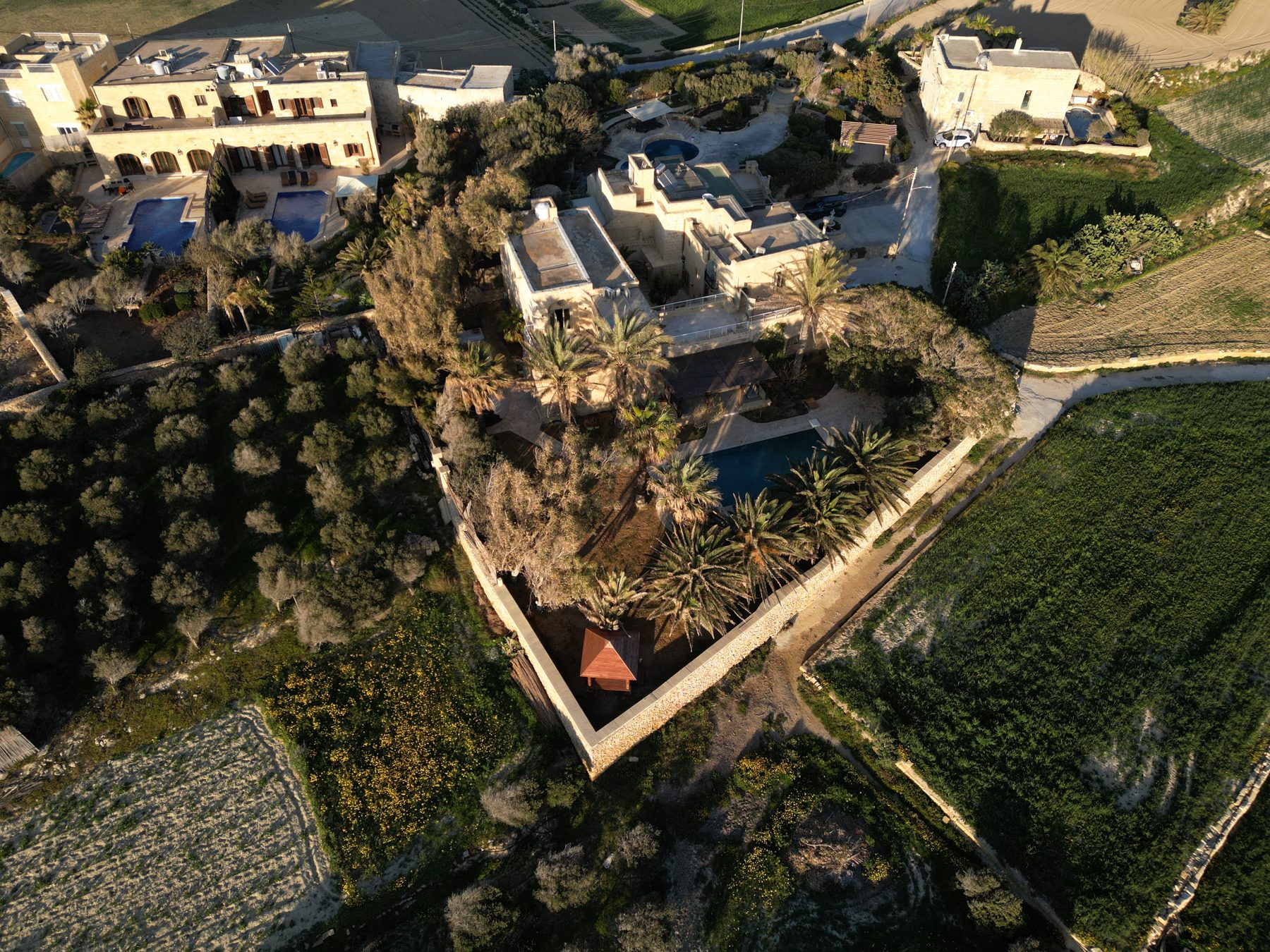
HIVE BIO runs a one-week residential ketamine therapy retreat in Malta inside a seven-week programme: three weeks of online preparation, a week in a stone house in San Lawrenz with one-to-one sessions, and three weeks of online integration with the same team. Four guests stay at a time. Two doctors, one of them a consultant psychiatrist, assess you before you pay for the programme, and a doctor and a nurse are with you throughout every session. We quote the price on the introductory call, in writing.
A ketamine therapy retreat is sold in three formats: a group weekend, an outpatient course of sessions near home, and a residential programme with medical supervision. The drug is the same in all three. What differs is who screens you before you pay, who is in the room during a session, and who is still working with you three weeks after you get home.
Most results for this search describe the group weekend: two or three days, several guests dosed on a shared schedule, a facilitator. A residential programme like ours works differently, with individual sessions and one team from preparation to integration.
Formats: a group weekend, an outpatient course, a residential programme
The three formats differ less in where you are than in who carries the responsibility: who decides whether ketamine is right for you, who watches you during the session, and who answers when the effect starts to fade. A group weekend, an outpatient course near home and a residential programme answer those three questions differently, and the table below sets out what each of them covers.
What you get and what you do not get in each
| Format | What you get | What you usually do not get |
|---|---|---|
| Group weekend retreat | Two or three days away, a group, a facilitator, a fixed schedule | Individual sessions; whether a psychiatrist assesses you first depends on the organiser; follow-up varies, often a few calls |
| Outpatient course near home | Sessions in a clinic, a prescriber, the option to keep working and sleep at home | Distance from the life you are trying to change, therapy (often not included), a single price |
| Residential programme | A medical assessment by two doctors before booking, individual sessions under medical supervision, one team from preparation to integration | A booking this week, dosing sessions shared with a group |
Which format fits follows from one question: can you take a week out of your life? If you can, the residential programme is the one of the three built around that week, away from the home, work and routine you are trying to change, with sessions that are yours alone and a doctor in the room for each of them. If you cannot, an outpatient course near home leaves your job and your evenings intact, and the therapy around the sessions is yours to arrange. A group weekend sits between the two: time away and other people to go through it with, on a schedule the organiser sets rather than a doctor. Write down which of the three you could clear the time for before you compare anything else.
How the weeks of the programme are built
The programme runs in three phases, and the week in Malta is the shortest of them. Preparation starts online three weeks before you fly, and integration continues online for three weeks after you land home. The same team carries you through all three.
Three weeks of online preparation, a week in Malta, three weeks of integration
Weeks 1-3 · online
Preparation
Three online sessions before you travel: what you want from the programme and why, how you live day to day, and how to go through the sessions.
Week 4 · Malta
Residential week
A medical assessment with the doctor on arrival, where the number of sessions and their days are decided. A doctor and a nurse stay with you through each session, and between them there is one-to-one therapy, group integration with the other guests, and rest.
Weeks 5-7 · online
Integration
Three structured sessions with the same team, working from the integration plan you take home in writing.
DetailMaximum four guests. Individual ketamine sessions. How the week in Malta runs
A seven-week programme with one week in Malta
Four guests at a time, individual sessions, a doctor and a nurse with you at each one. Two doctors, one of them a consultant psychiatrist, decide whether the programme fits you before you pay for it.
No payment and no booking at this step.
Ketamine treatment for depression comes as a course, not a single dose. The usual shape is a first run of several sessions across a few weeks, sometimes called an induction series, followed by a decision about whether and how to continue.
Routes differ in how predictably the drug is absorbed, so the same dose on paper can produce different effects depending on route.
After the first run. Some people hold the benefit with no further dosing. Others relapse within weeks and are offered maintenance sessions, often called boosters, at intervals set individually. Maintenance without regular review, or doses that climb without a stated reason, is a warning sign and not a sign of thoroughness.
What surrounds the dosing matters as much as the dosing. Preparation beforehand, structured integration afterwards, and continuity of the clinical team separate a treatment programme from a run of appointments. The drug opens a window; what happens in that window decides whether anything holds.
A credible course has an end point set in advance and a review at that point, including a review of whether treatment should stop.
Checked for medical accuracy by Dr Christopher Gauci, MD MRCS(Ed) EDAIC on 1 October 2026. The check covers this section. Everything else on the page is written by our editorial team and verified against primary sources.
Most weekend formats end their in-person work when you leave; integration, where offered, is usually a few calls. The weeks after the last session are the stretch the three weeks of online integration cover. They are booked before you fly.
The programme ends with the written integration plan you take home and a conversation with your doctor about what, if anything, comes next. The first step is a two-minute fit check and a call.
Who leads: names, specialties, registration with the Medical Council of Malta
Three clinicians lead the programme, three nurses cover the sessions, and every one of them is named on the site, not after you enquire.
Dr Peter Muscat, consultant psychiatrist, and Dr Christopher Gauci, anaesthetist, are the two doctors who decide whether the programme fits you. Both are with you for the whole week on the island.
Dr Gauci is the Medical Lead and runs the medical side of the sessions. A doctor and a nurse are with you throughout each one.
Audra Micallef, Chief Psychotherapist, has twenty years of practice and leads the integration work. Maryanne Vella, an operating theatre nurse since 1983, runs operations on site.
Both doctors are registered with the Medical Council of Malta, and the national register can be searched by name. That is the check to run on any programme you are considering: whether the people who assess and supervise you are named and can be looked up. Their profiles are on the team page.
Hive Bio is a retreat centre with a ketamine-assisted therapy service in Malta, run by HIVE BIO Malta LTD, company number C 94710.
Therapy alongside the drug and what the studies show
Ketamine-assisted therapy means sessions under supervision with psychotherapy built around them: preparation before, so the sessions have a purpose, and integration after, where the sessions are worked through with the same team.
The widest view so far is a systematic review of ketamine-assisted psychotherapy: 64 papers covering 72 studies, of which only 11 were randomised trials. Clinical effects were reported across depression, PTSD and other diagnoses, and against psychotherapy alone this route was linked to better engagement in treatment and a response that held longer (Veraart and colleagues, Clinical Psychology Review, 2026). What the review cannot settle is how much the psychotherapy itself adds, because only two of those studies randomised the therapy.
The largest single body of outcomes comes from a commercial network of eleven ketamine clinics in North America, where adults with depression, generalised anxiety or PTSD that earlier treatment had not helped had four to six sessions, by injection into a muscle or as a lozenge under the tongue, with therapy visits between doses, and rated their own symptoms afterwards. Of those still answering at three months, 50 to 75% reported an improvement large enough to notice in daily life, depending on the condition; at six months the figure was 48 to 70%, with 94 people left to answer by then (Yermus and colleagues, Psychedelic Medicine, 2024). The number who stopped answering grew with time, 82% by three months and 95% by six, and no group was given ketamine without therapy.
Neither source describes a residential week, so both speak to the drug and the therapy around it rather than to our format. What they do show is that, for many of the people who kept answering, the change was still there months after the last session, and the three weeks of online integration cover those first weeks back home. What ketamine-assisted therapy involves here is set out in full.
How the doctors decide what suits you
Two doctors decide, and they decide on what they can see: your current health, every medication you take, the treatments you have already had and how you responded to them, and what you want this course to change. From that they either build the week around you or name what needs to happen first, and why, so you hear the reasoning rather than a yes or a no.
There is a second conversation on arrival on the island. The doctor sees you again before anything else is planned, and this is where the number of sessions and the days they fall on are set, around how you are that week. You can talk the programme through with the team first.
Cost and what is included: one all-inclusive price instead of per-session pricing in the US, UK and EU
Our programme is quoted as one price for the whole course. It covers the three weeks of online preparation, the week in residence with the sessions and medical supervision, the single room, meals and activities, and the three weeks of integration with the same team. Nothing is billed per night. Flights are not included; we meet you at the airport and arrange the transfer.
In the US, the UK and most of the EU, ketamine treatment is usually priced per session. Psychotherapy, the first consultation and follow-up are billed on top, and travel and time off work are yours to add. A per-session price looks smaller on the page, and the full course only becomes clear once it is added up. What the single price buys here is the whole route with one team: the same doctors all week, four guests at most, a single room each, and the rest of a session day left free, so what came up has time to settle.
The figure is given on the introductory call, in writing, ahead of any payment for the programme. What the week in Malta contains is described in full, so you can see what the price covers before the call.
How to book an assessment
The first step is a fit check: five questions, two minutes, and at the end you pick a time for a call. You do not need a referral from your own doctor, though the medical assessment later goes through the medication you take now and the treatment you have already had.
The call is 15 minutes with our concierge team. You ask about the programme, the house and the week, hear what happens next on the medical side, and get the price. Your medical history is not discussed on this call.
The appointment with Dr Muscat and Dr Gauci follows, and that is where it is decided whether the programme fits. If it does not, you hear why and what would need to change. Dates are chosen only after that, and you pay for the programme after it. Start with the fit check.
Common questions
What happens at a ketamine retreat?
At a group weekend, several guests are dosed on a shared schedule with a facilitator. In our programme, sessions are individual and supervised by a doctor, with integration work between them and rest around them, after three weeks of online preparation. If you are comparing retreats, note down who is in the room during a session and whether the same team does the preparation and the integration, then apply through a two-minute fit check.
How long does a ketamine retreat last?
Group retreats usually last two or three days. Ours runs in three phases: three weeks of online preparation, a week on the island, and three weeks of online integration with the same team. The week in residence is the shortest part, and the dates are yours to pick once you apply.
Is a ketamine retreat covered by insurance?
Ours is paid privately and is not billed to an insurer. Whether any part can be claimed back depends on your policy. The full price is given in writing on the introductory call, so you can apply first and put your policy to the team on that call.
What is the difference between a group ketamine retreat and a residential programme?
A group retreat doses several guests together over a weekend. A residential programme like ours has two doctors assess you before booking, keeps sessions individual under medical supervision, and works with you for weeks before and after. Ours takes four guests at most, and you can apply with a two-minute fit check.
Start from whether you can take a week out of your life: if you can, a residential programme uses it, and if you cannot, an outpatient course near home is the format that fits around work. Whichever you look at, check three things: who decides you can be dosed, whether the sessions are yours alone or shared, and what happens in the weeks after the last one. Ask for those three in writing, and ask whether the therapy around the sessions is included or billed separately.